HR Target Operating Model

How do we give HR a key role in achieving organizational goals?

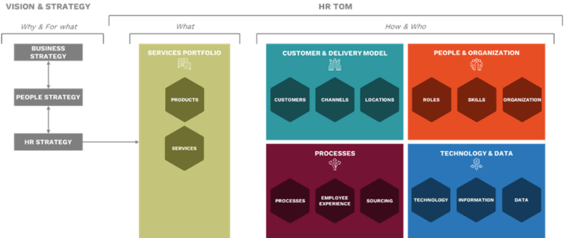
Start by establishing a powerful HR Target Operating Model (HR-TOM).

We've previously written two blogs on HR-Target Operating Models: one explaining the basics and another on what to look out for when designing them.

And as you've come to expect from Kyden, we haven't been idle. While there is no one-size-fits-all HR-TOM, there are set ingredients that help us design an effective HR-TOM.


HR-Target Operating Model

HR's role in ESG, CSRD, SDGs, or making impact

Based on the urgency to have a positive impact on the world, we went to the drawing board to firmly revisit the concept of HR TOM based on things we see happening in daily practice. Add to that CSRD legislation and the movement toward ESG themes, and the People & Culture/HR/P&O department needs to get to work!

The human factor

HR is the first point of contact for the human factor, and HR defines what good employment practices should look like. In this regard, HR is increasingly being addressed on topics such as sustainable employability, diversity, inclusion and wellbeing. Employees find the human factor increasingly important, and from the perspective of the increasing talent scarcity, this factor is becoming a unique selling point.

Corporate Social Responsibility advocates "running the business with respect for people, society and natural environment." The shift of looking at Human Value rather than Human Resources encourages this same mindset. Work is intertwined with people's identities and with that, expectations of that work increase.

We therefore argue that as an organization you should facilitate employees(people) in such a way that they can also make a positive contribution to society and the environment outside of work(natural environment). But also that your people responsibility reaches further than just taking care of your own employees, but of all people involved in the chain of your organization.

This requires HR to take a fundamentally different approach than viewing your employees as resources.

Technology

Technology has an important role in our society and technology is expected to become even more intertwined in our daily lives in the near and distant future. Technological developments give rise to change and innovation and, at the same time, technology is a means to achieve goals.

Looking at the role of technology in organizations, we see two extremes. The organization where technology is the core of the business. There we do not mean that the product of the organization is technical/IT related, but that technology and data are deployed to the capillaries of the organization. On the other hand, the organization that deploys technology purely supportively to automate some business processes.

The way the organization is oriented to technology and data also has a direct impact on the services provided by HR and more importantly, how HR organizes itself to facilitate the employees and teams in that organization.

Technology in HR has so far mostly focused on functional (HR) support while organizations increasingly need data and technology that directly provide for their primary task of promoting well-being and social connectedness, facilitating democratization of decision-making, providing unbiased recruitment, etc.

Agility

The terms "director," "leader" and "employee" are becoming obsolete. A general awareness is emerging that we need each other - based on qualities and independent of titles - to work faster, more flexibly and more results-oriented. And this is badly needed as Darwin already knew: "Agility is essential for survival."

Integrality, collaboration, coalitions and ecosystems are the magic words in organizational design and new ways of working. And for HR a way to create more and faster value.

When it comes to new ways of working and organizing, HR is often looked to for facilitation. Then it is important that HR understands the dynamics of the organization and the market and knows how to translate this understanding into organizational and collaboration structures. To remain continuously relevant to the organization, it is wise for HR to be a role model in this in the context of "practice what you preach."

Essence

The aforementioned three elements - the human factor, technology and agility - are, in our opinion, essential in any design of HR TOM and should answer to what extent these elements are important in the organization. What does it mean for HR services and ultimately, what is the impact on the way HR is organized?
David van Kampen
David van Kampen
Business Unit Lead People & Organizational Design

Discuss the possibilities

Contact David van Kampen to find out how HR Targeting Operating Model (HR TOM) can help your organization move forward.